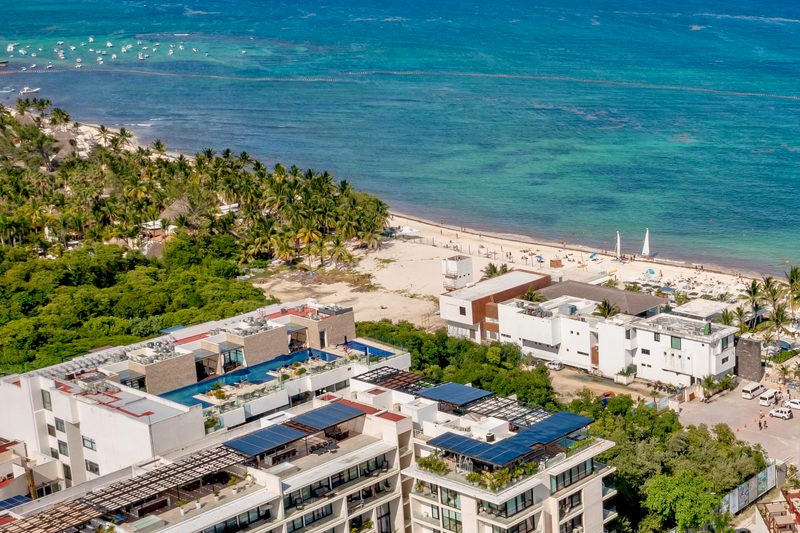
Sargassum is usually heaviest on the Playa del Carmen coast from April to October, with the Atlantic-wide peak typically in June or July, and lightest from November to March. December to February has the lowest chance of big piles on the beach. That is the usual pattern, not a forecast, and 2026 did not follow it: arrivals started in January and the national environment ministry, Semarnat, called it the worst season on record. So plan around the pattern, then check the actual beach before you commit to a beach day.
The usual calendar
The University of South Florida's Sargassum Watch System, which tracks the seaweed by satellite, says abundance in the Atlantic typically peaks in June or July and is lowest in winter. UNAM's sargassum research group, as reported by El Universal, puts the low season at November to March, with December to February the lowest chance of large accumulations on the beach.
Here is how we read that for a trip:
- December to February: usually light. This is also high season, so it is the busiest and the most expensive time to come.
- March: usually light, with the chance rising toward spring.
- April and May: the season starts. Some beaches see it, others stay clear.
- June and July: typically the heaviest months.
- August to October: often still heavy, then easing.
- November: usually light again.
Our month-by-month guide puts this next to rain, sea temperature, hurricane season and crowds, and each month has its own page, for example June, July and October.
What 2026 actually looked like
Local press reported on October 1, 2026 that Quintana Roo had collected about 138,000 tonnes of sargassum so far, with projections above 150,000. For comparison, the same report cites 92,782 tonnes collected in all of 2025. It also says arrivals began in January rather than March, and calls 2026 the first year without a clearly defined start or end. It gave two monthly figures: 6,684 tonnes in August and 1,700 in September.
By October 8, the Secretaría de Marina rated the level in Quintana Roo as very low, a green traffic light, with about 3,920 tonnes at sea. On the same day the state environment secretariat counted its 140 monitored beaches as 21 excessive, 34 abundant, 26 moderate, 49 low and 5 with none (the report's categories add up to 135 of the 140). Those two readings come from different agencies using different methods, so do not add them together. What they show is that the same week can be easy at one beach and hard at the next.
The USF outlook for September 2026 said amounts were declining but still high compared with the same month in earlier years. So even in a quieter month, check.
How to check on the day
Three free sources are worth bookmarking before you travel:
- The SEMAR daily bulletin. The Mexican Navy publishes it, prepared by its oceanographic institute for the Gulf and Caribbean. Its index page lists a bulletin for October 13, 2026 as we write.
- SATsum from CONABIO. It shows satellite maps and trends for the Mexican Caribbean, a 10-day drift forecast for the Quintana Roo coast, and live webcams. The page itself calls the forecast experimental and says to use it to decide where to look, not to predict exactly where sargassum will land.
- The USF monthly outlook. It gives a general probability for the whole Caribbean, not a beach-by-beach answer.
Then do the simplest check of all: look at the beach. A bulletin tells you what the sea is doing. The sand tells you what you will actually sit on. Mamitas Beach is a one-minute walk from our building, and the first thing to do each morning is take a look. A heavy morning can look different by afternoon, because wind and current move it.
Plan B for a heavy day
None of these cost a day of your trip:
- Pool time. Our penthouse has a private rooftop pool with ocean views, and the building has a shared pool with a bar. One June 2026 beach club guide singles out the pool at Tata (formerly Kool) as especially useful during seaweed season.
- A cenote or a cave river. Inland freshwater is not touched by sargassum. See our day trips and adventures page for options such as Dos Ojos and Rio Secreto.
- A spa afternoon. The Okom spa circuit is next door. Our wellness page has it.
- A town day. 5th Avenue, Parque Fundadores and the shops by the ferry pier do not depend on the sea.
Choosing your month
If avoiding sargassum is your top priority, December to February is your best bet, and you will pay for it in crowds and prices. If you can live with some seaweed in exchange for warmer water, fewer people and lower rates, the shoulder months and the summer work well, and you build in a few Plan B days. Each month has trade-offs. June to October is also the Atlantic hurricane season, which runs June 1 to November 30 and peaks around September 10, so sargassum is rarely the only thing to weigh.
One last practical point. If the beach is bad on the day, the water is still warm and the rest of town is still there. Check the bulletin, look at the shore, and keep a pool day or an inland day ready.