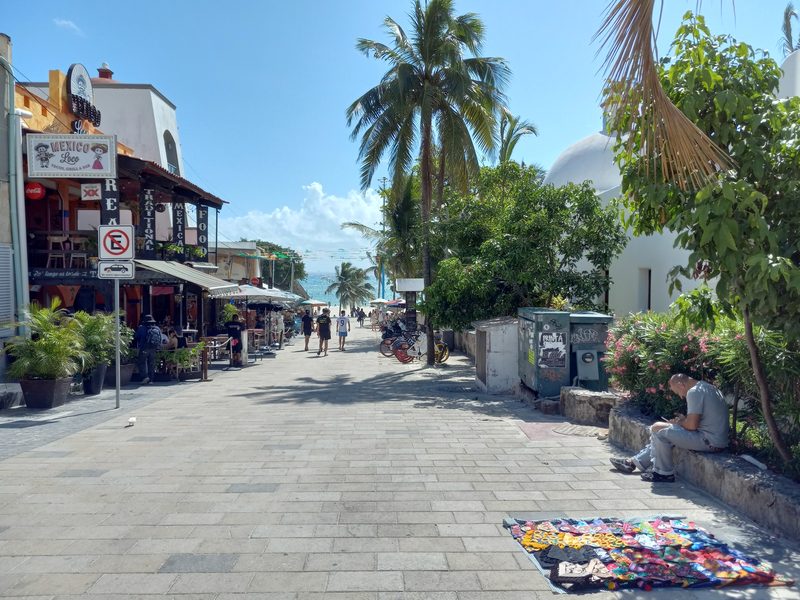
For a group of eight to ten, pick Playa del Carmen if you want to walk from your beds to the sand, to dinner and to a bar without arranging a single ride. Pick Cancun if you want one large resort that contains everything, and a nightlife strip you do not have to plan around. Both are in the same state, both use the same airport, and they sit about an hour apart.
That is the short answer. The rest is the reasoning, because the two places are built so differently that the right choice usually becomes obvious once you can see the shape of each one.
Cancun is a planned resort strip. Playa is a town.
Almost everything else follows from this one fact.
Cancun's Zona Hotelera, the Hotel Zone, is a narrow island shaped like the number 7, roughly 14 miles end to end, with the Caribbean on one side and the Nichupte Lagoon on the other. A single road, Boulevard Kukulcan, runs its whole length from downtown out to the airport end, and hotels line it. Addresses are given as a distance along that road rather than as a street corner.
It is that way on purpose. Mexico's tourism development fund counts Cancun as the country's first fully planned tourism center, in operation since 1974, a development of about 31,000 acres with roughly 14 miles of beach frontage. The plan deliberately put the hotels on the sandbar and the city for residents on the mainland. Downtown Cancun, El Centro, is that second place: a working city, not built for visitors, and most groups staying in the Hotel Zone never set foot in it.
Playa del Carmen was not planned. It grew from a fishing village into a town of about 305,000 people, the second largest in Quintana Roo at the 2020 census. It sits on a grid: numbered streets run from the highway down to the water, with the beach at the bottom of every one of them. 5th Avenue is closed to cars and runs parallel to the sand, from the Cozumel ferry pier north past Calle 40. Dinner, a bar, a pharmacy and the sea are all within a few blocks of each other.
So in Cancun the resort is the amenity. In Playa the town is.
You land at the same airport either way
Both trips start at Cancun International, which the airport group ASUR operates, and which lists ADO buses, taxis and car rental on its own ground transport page. The Hotel Zone is close, at the southern end of the strip, usually about 20 to 30 minutes.
Playa del Carmen is about 33 miles south on Highway 307, 45 to 60 minutes by road. The ADO bus takes 1 hour 15 to 1 hour 50 and runs up to 30 times a day. For a group it is one van either way, so that extra hour is a smaller penalty than it looks on a map. Getting here has the detail.
An ordinary evening, which is where groups feel it
In Playa: everyone gets ready, walks out of the gate, eats on one street and drinks on another, and whoever wants an early night walks home on their own. Nobody coordinates a ride. Nobody waits for the slowest person to be ready.
In the Hotel Zone: you eat inside the resort, or you arrange transport in both directions. The nightlife is concentrated and genuinely good at what it does, but it is an outing rather than a walk. With ten people and ten different bedtimes, that one distinction shapes more of the week than anything else on this page.
The beach
Beaches in Mexico are federal public property. The environmental regulator defines the federal zone as the passable strip of firm land next to the sand, about 65 ft wide, and the state governor has put the principle plainly: access is a right, not a privilege.
Reaching the sand still differs. In the Hotel Zone the beach is wide and the water is hard to beat, and most of the frontage sits behind resorts, with marked public beaches spaced along it. If you are staying on the strip, you walk straight out of your hotel.
In Playa the sand is at the end of the numbered streets, so any one of them gets you there from anywhere in town. Mamitas is the main stretch.
Sargassum affects both the same way. The Mexican navy puts the Quintana Roo season from April through October, and it is the same water for both towns. Hurricane season is shared too: NOAA runs it from June 1 to November 30, with the peak around September 10.
What Cancun does better
Honestly:
- All-inclusive at scale. One price, one wristband, no decisions. Cancun has far more of it and does it better.
- A large, concentrated nightlife strip.
- The airport is 20 to 30 minutes away instead of an hour.
- Wide hotel beaches with loungers and service already set up.
What Playa does better
- You can walk to everything, which for a group is the single largest difference in daily life.
- Local food at local prices, a few blocks inland from the tourist street.
- The Cozumel ferry leaves from the pier at the foot of 5th Avenue, about 45 minutes across. From Cancun, Cozumel turns into most of a day before you even start.
- Tulum, Coba and the cenotes all start closer.
- A train station. Playa del Carmen is a stop on the Maya Train's northern stretch, and so is Cancun airport.
Safety
Same state, same advisory, so this is not a tiebreaker. The U.S. State Department lists Quintana Roo at Level 2, "Exercise Increased Caution," as of October 2026, and that covers Cancun, Playa del Carmen, Cozumel and Tulum alike. Ordinary care applies in both.
How we would choose
If your group wants a week handed to them with nothing to decide and nobody having to organize it, book a big all-inclusive in the Hotel Zone. That is a real and good holiday, and Cancun is better at it than Playa is.
If your group would rather open a door and be in a town, choose Playa. At eight to ten people the walking compounds: no vans, no waiting, no splitting up by who booked which excursion. That is why we are here and not there.
If you are weighing Playa against Tulum rather than Cancun, that comparison is here.